
1 like


 xpaper
1 year ago
xpaper
1 year ago
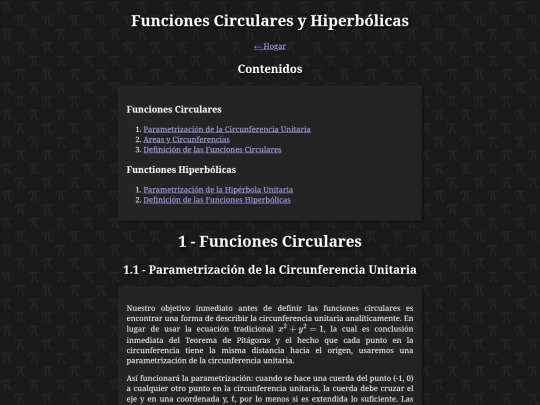
Given that I haven't updated the notes on the circular functions in ages, I decided I might as well start making the translations. First, Spanish

1 like
xpaper
1 year ago
decided to add a funny thing on one of the pages. whatever. one day i'll make an actually good update on the math notes or something one day i promise. youtube has me distracted.
1 like





1 like
xpaper
1 year ago
I AM ALIVE and I have once again decided to overhaul the navigation because I am indecisive.

2 likes
1 like
xpaper
1 year ago
redid the UI again so it takes up less space. if you're seeing that the site content takes up almost no space, the thumbnail just needs to refresh
1 like
Finally overhauled the website. Now everything is in an iframe and there's a bar at the top for navigation.
3 likes

IM ALIVE.
4 likes
xpaper
1 year ago
I'll get back to updating the site eventually, but i think the whole thing could use an overhaul
2 likes

1 like
>the_quintic_problem By the way historically the origin was the quintic problem. But that era has ended and Galois theory is used in number theory the most. I could even say that it is basically linear algebra for number theory. So study hard if you were interested in number theory.
1 like
>the_quintic_problem Therefore an equation of degree n has general solutions if and only if Sn is solvable. And since Sn is a finite group, it means whether Sn has a composition series in which all factor groups are Zp. This corresponds to that by adding the primitive p-th root of unity, you can extend the base field to the field that factorizes the polynomial. But for n>4, An is simple so that Sn is not solvable.
1 like


![[tfpXE] avatar](/site_screenshots/15/25/tfpxe/index.html.50x50.webp)


I've just started learning Esperanto!
Very excited to hear that!